Multi-expert chat

Ask several experts at once

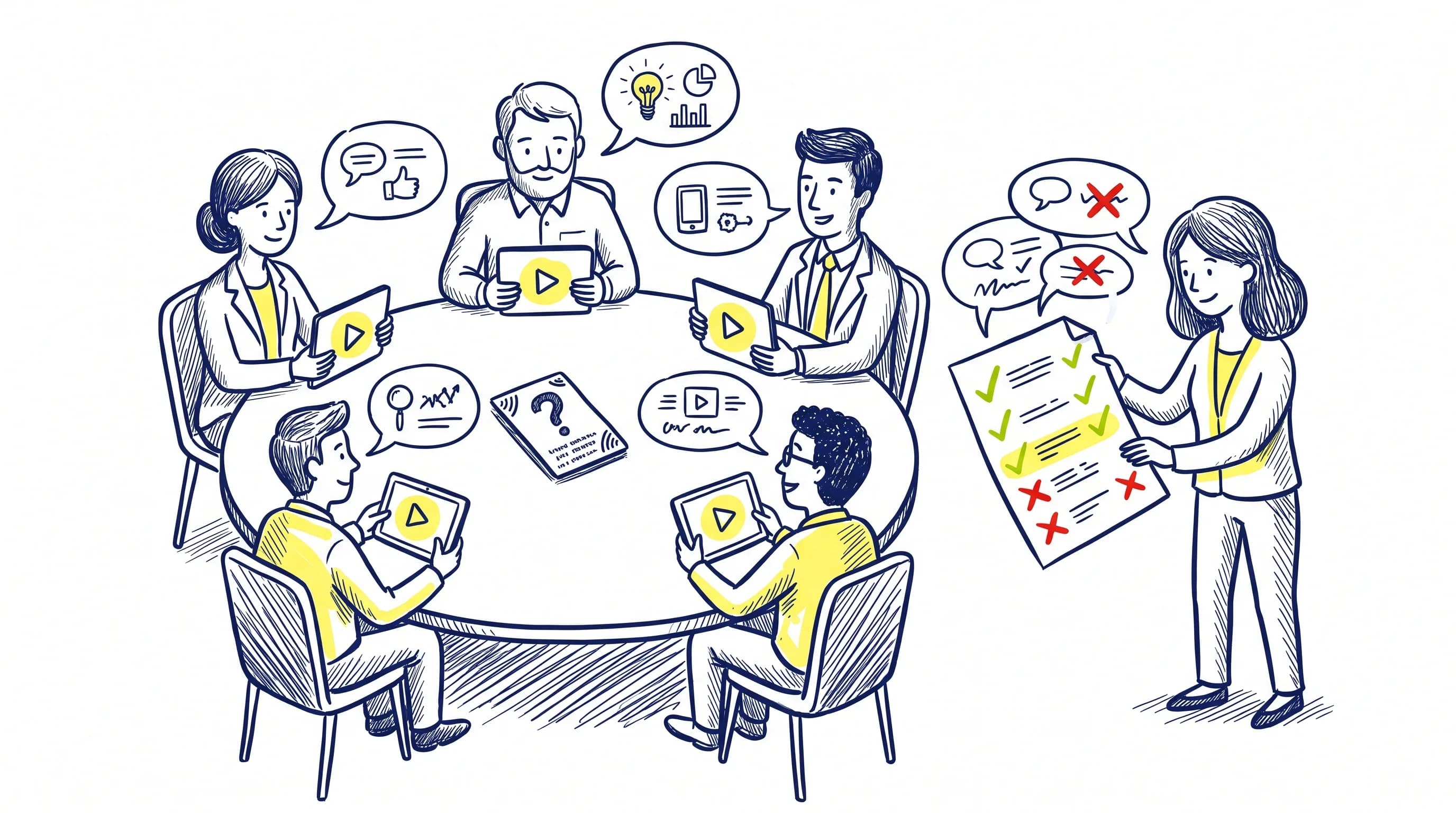
One question, several YouTube channels answering in parallel, each from its own videos and citing the exact minute. Then a synthesis tells you where they agree and where they do not.

No sign-up. The demo runs on channels that are already indexed.
Several experts answer the same question and agreements and disagreements are summarised
Try it with a real question

This is what three real channels answered

Real panel answers, generated from each channel’s videos. Click any minute and it plays right here.

You ask

«How will artificial intelligence change our work?»

Area: Artificial intelligence

Dot CSV

Artificial intelligence will transform work by giving a decisive competitive edge to those who adapt quickly ▷ 22:35, by reshaping every layer of software—not just browsers or search—so that entire categories of applications are redefined ▷ 35:21. It is already being used to accelerate critical sectors such as biotechnology, where AI helps design new drugs ▷ 11:11, and to generate new scientific knowledge autonomously, turning research into a rapid, data‑driven process ▷ 16:45.

In software development the shift is from simple autocomplete to “agentic” AI that can execute complex tasks autonomously; a few minutes of AI work now translates into hours saved for humans ▷ 2:04. This same automation extends to routine office tasks—drafting emails, filling documents, writing scripts—while still requiring human oversight ▷ 1:30:35.

The broader impact includes societal applications like disaster‑relief logistics ▷ 2:10:04 and the emergence of new challenges such as large‑scale disinformation, which will require new safeguards ▷ 1:30:35. Overall, AI is moving from a supportive tool to a core collaborator that can both accelerate productivity and reshape how work is organized across industries.
Area: Psychology and wellbeing

Alex Fidalgo

Artificial intelligence will make work faster and shift the value of human effort toward tasks that add real societal value, while automating low‑value, repetitive activities.

  • The speaker says the coming AI wave will “make everything go faster … not only cars and bicycles but also the human mind” and that this speed‑increase will be felt across companies ▷ 1:20:45.
  • Jobs that depend only on manual effort or on pressing a button are the first to be at risk; workers who do not reskill will be most affected ▷ 1:07:28.
  • Studies cited in the video estimate “170 million jobs created thanks to artificial intelligence by 2030 and 70 million jobs eliminated” ▷ 1:07:28, indicating a net gain but also a restructuring of the labour market.
  • The AI that will be widely used in the near term is narrow (ANI); tools like ChatGPT belong to this category and excel at single‑purpose tasks such as generating podcast episode descriptions from a transcript, “understanding the conversation, extracting key points and producing a faithful description” ▷ 1:54:11.
  • Professionals can integrate AI to handle peripheral tasks—e.g., an AI “agent” that checks Slack hourly and alerts only when something important occurs, reducing mental noise ▷ 1:44:10.
  • The speaker argues that the human, emotional component of work will remain essential; the contact and empathy required in many roles cannot be fully replicated by AI, so the “human contact in work will continue to be necessary” ▷ 1:08:31.
  • By 2030 the industry expects language models that approach general AI, but the exact impact is still uncertain; what is clear is that anyone who adds “close to zero value to society” will see their role questioned, while those who adapt and add value will stay relevant ▷ 1:18:09.

In short, AI will accelerate processes, automate low‑value tasks, create many new roles, and push workers to upskill and focus on high‑value, human‑centric activities.

Area: Business and entrepreneurship

spicy4tuna

Artificial intelligence will reshape work by automating tasks and reshaping job roles. The video notes that AI “va a destruir” (will destroy) certain occupations early on (▷ 0:30 and ▷ 7:55), indicating that some jobs may disappear as machines take over repetitive functions. At the same time, AI is already embedded in many sectors (“inteligencia artificial está en los…”) (▷ 1:41 and ▷ 2:02:23), showing that it is becoming a ubiquitous tool across industries. The impact of AI on work is discussed throughout the video (▷ 7:33 and ▷ 10:36), emphasizing both the challenges and opportunities it creates. Finally, the speaker promises to teach viewers “cómo” to adapt and work with AI (▷ 1:06:41), suggesting that learning new skills will be essential to thrive in an AI‑driven workplace.

The minutes are links: click one to hear the creator say it.

How it answers

Parallel answers, synthesis and debate

What multi-expert does today, no frills.

Parallel answers

Your question reaches every chosen expert at once. Each one searches its own videos and answers with its sources, so you see each creator’s nuance without anyone summarising it for you.

In the multi-expert chat

You pick the experts and the conversation mode:

  • Conversation

    Collaborative answers from the experts you chose.

  • Debate

    Opposing perspectives on a topic, to see where each stance comes from.

Comparative synthesis

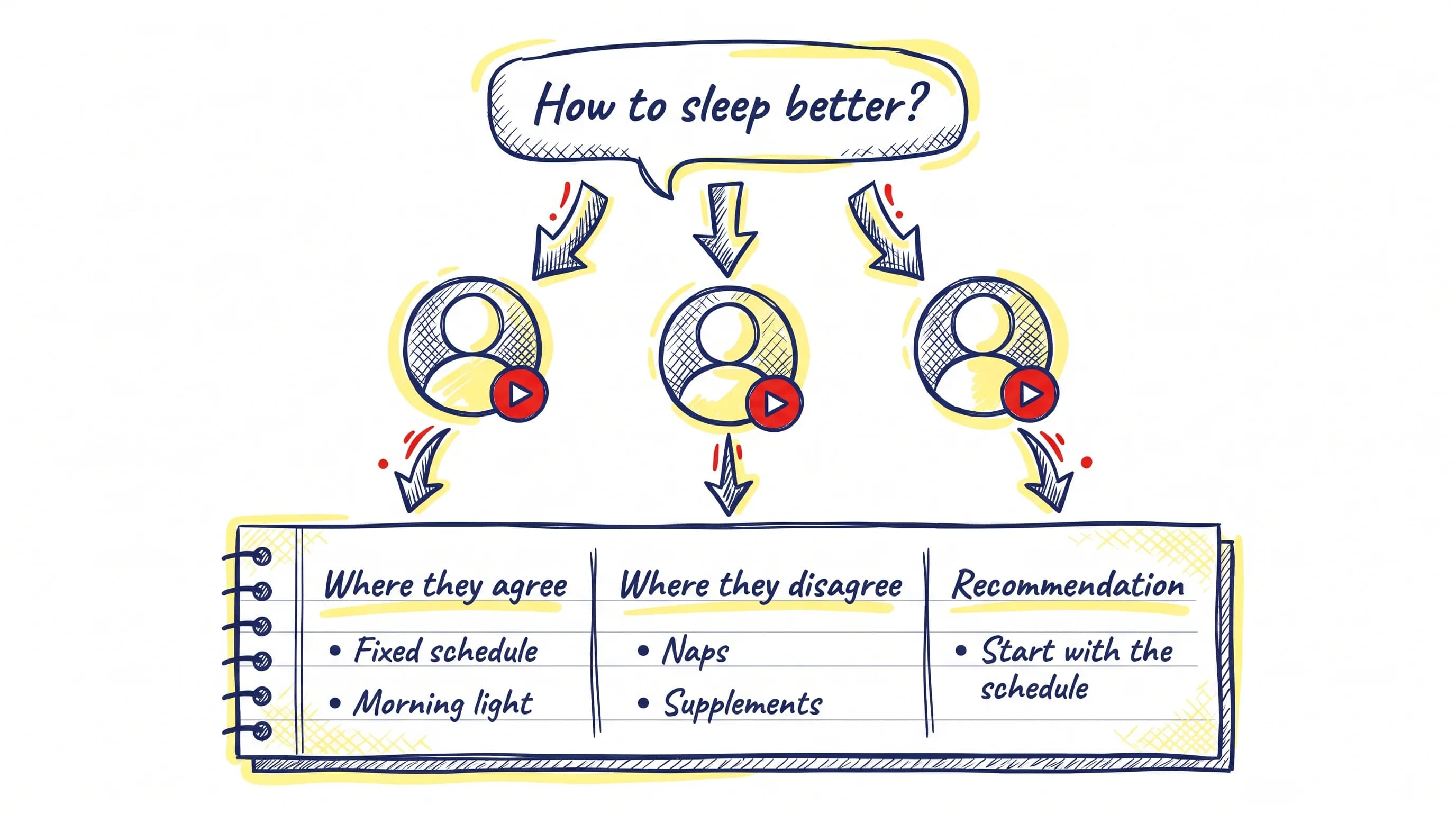
A read that cross-references all the answers and organises them in four parts:

  • Summary

    The main ideas of every expert merged into one text.

  • Consensus

    What every expert agrees on: the solid ground to act on.

  • Differences

    Where they diverge, so you can see what depends on your case.

  • Recommendation

    A practical conclusion based on all the perspectives.

The multi-expert synthesis: where they agree, where they disagree and the recommendation
How many experts

How many experts in a single question

It depends on your plan. A free account already lets you compare two.

Explorer

2

experts

2 panel questions a week

Pro

3

experts

30 panel questions a month

Max

5

experts

80 panel questions a month

Team

10

experts

80 panel questions a month (per seat)

Gather your experts and ask them all

Start with the demo, no sign-up, or create a free account and pick your own channels.